Men's Leather Motorcycle Vest Sizing Guide – Find Your Perfect Fit
By Adam Milo
110 Views
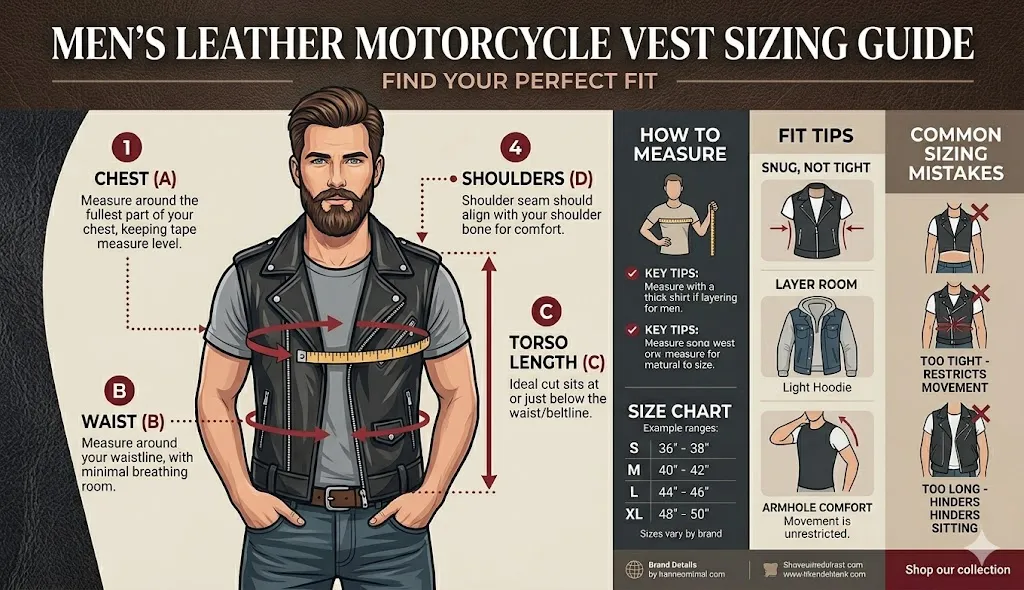
Buy a vest that doesn't fit right, and you've wasted your money. Too tight and it pulls across your chest, restricts movement, and looks strained. Too loose and it flaps in the wind, looks sloppy, and defeats the purpose of a fitted vest.
Getting the right size in a men's leather motorcycle vest isn't about guessing or ordering your usual shirt size and hoping it works. Vests fit differently than jackets or shirts, and leather behaves differently than cotton or synthetic fabrics.
Here's how to measure correctly, read size charts, and find a vest that actually fits your body.
Why Vest Sizing Matters More Than You Think
A poorly fitted vest isn't just uncomfortable, it changes how you look and how the vest performs.
Vests that are too small create pulling across the chest and back. The snaps or zipper strain to close. Your shoulders feel restricted. You can't move naturally, and the vest looks like you borrowed it from someone smaller.
Vests that are too large hang off your shoulders, gap open at the sides, and shift around while you ride. They catch more wind, look baggy, and don't provide the clean silhouette a vest should.
Leather doesn't stretch like cotton. A vest that's too small won't "loosen up" enough to fix a sizing mistake. And unlike adjustable clothing with elastic waistbands or drawstrings, most vests have limited adjustability, usually just side laces or a belt in the back.
Getting the size right from the start saves you the hassle of returns, exchanges, and settling for something that's "close enough."
How to Measure Yourself Correctly
Accurate measurements are the foundation of good fit. Don't skip this step and don't eyeball it. Grab a soft measuring tape and take five minutes to do it right.
Chest Measurement
This is the most important measurement for vest sizing.
Stand naturally; don't puff out your chest or slouch. Wrap the measuring tape around the fullest part of your chest, typically right across your nipples. Keep the tape parallel to the floor and snug against your body without compressing your chest.
Breathe normally when taking the measurement. Don't hold your breath or exhale completely.
This number is your chest measurement. Write it down.
Waist Measurement
Find your natural waist, which is usually an inch or two above your belly button, the narrowest part of your torso. Don't measure where your jeans sit.
Wrap the tape around your waist, keeping it level. Again, snug but not tight. Don't suck in your gut. You need your actual measurement, not what you wish it was.
Shoulder Width
Measure from the edge of one shoulder (where your shoulder meets your arm) straight across your back to the edge of the other shoulder.
This measurement helps determine whether a vest's shoulder seams will sit at the right spot. If you're measuring yourself, have someone help with this one, it's nearly impossible to get accurate shoulder measurements on your own.
Body Length
Measure from the base of your neck (where your neck meets your shoulders) straight down your spine to where you want the vest hem to fall.
Some riders prefer vests that hit right at the belt line. Others want them slightly longer. Know your preference before measuring.
Pro tip: Wear the type of shirt you'll typically wear under the vest when taking measurements. A tight t-shirt versus a thick flannel makes a difference.
Reading Size Charts Like a Pro
Once you have your measurements, compare them to the manufacturer's size chart. Every brand sizes differently, so don't assume a "large" from one company equals a "large" from another.
- Match your chest measurement first. This is the primary sizing indicator for genuine leather motorcycle vests for men. If your chest measures 42 inches and the size chart shows that a large fits 40-44 inches, you're in the large range.
- Check the other measurements too. Just because your chest fits a large doesn't mean your waist or shoulders do. Look at all the numbers.
What if you're between sizes?
If your measurements fall right on the line between two sizes, consider these factors:
- How do you want it to fit? Prefer snug? Go with the smaller size. Want room to layer? Size up.
- Does the vest have side laces? Adjustable side laces give you about 2-4 inches of flexibility, so you can size down slightly and adjust to fit.
- What's your body type? Broader shoulders with a narrow waist? You might need to size for shoulders and use side laces to taper the waist.
- Red flag: If your chest measures a medium but your waist measures an XXL (or vice versa), standard sizing might not work well. You may need custom sizing or a vest with significant adjustability features.
Key Fit Points to Check
Numbers only tell part of the story. When you try on a signature men's leather motorcycle vest, check these specific fit points:
Shoulders Sit at the Right Spot
The shoulder seam should sit right at the edge of your shoulder, where your shoulder meets your arm. Not sliding down your arm. Not pulling toward your neck.
If the shoulders don't fit, nothing else will line up correctly. This is non-negotiable.
Armholes Don't Cut In
Raise your arms like you're gripping handlebars. The armholes shouldn't dig into your armpits or restrict movement. You should be able to reach forward comfortably without the vest pulling tight across your back.
Armholes that are too small make the vest uncomfortable after 20 minutes of riding. Armholes that are too large look sloppy and allow the vest to shift around.
Chest Closes Without Straining
Snap or zip the vest completely. It should close without pulling, gaping, or creating X-shaped stress lines across the chest.
At the same time, it shouldn't be so loose that there's space between the vest and your body. A properly fitted vest sits close to your torso without being skin-tight.
Length Hits Where You Want It
Check the hem length while standing and while seated. The vest should cover your belt line without being so long it bunches up when you sit on the bike.
Most vests are designed to hit right at or slightly below the waist. If it's riding up above your belt or hanging down to your thighs, the size is wrong.
Side Laces Function Properly
If the vest has side laces, make sure you're using them in the middle of their adjustment range. If you have to lace them as tight as possible just to get a decent fit, the vest is too large. If you can't loosen them at all without the vest being too tight, it's too small.
Side laces should fine-tune fit, not compensate for buying the wrong size.
Common Fit Problems and How to Fix Them
- Problem: Shoulders fit perfectly but the chest is too tight.
- Solution: Size up and use side laces to adjust the waist. You can always take fabric in, but you can't add room through the chest.
- Problem: Chest fits but shoulders are too wide.
- Solution: The vest isn't the right cut for your body type. Try a different brand or style with more athletic proportioning.
- Problem: Vest fits standing but rides up when you sit on the bike.
- Solution: The body length is too short. Look for vests with a longer torso cut or check if the vest you're wearing is designed for cruiser versus sportbike riding positions.
- Problem: Gaps between snaps across the chest.
- Solution: The vest is too large. Size down or look for vests with more snaps placed closer together.
- Problem: Can't close the vest completely.
- Solution: It's too small. Size up. Don't convince yourself leather will stretch enough to make up the difference, it won't.
Leather Break-In: What to Expect
New leather feels stiff. That's normal. A vest that feels slightly snug when brand new will relax and conform to your body after several wears.
Quality cowhide or buffalo leather softens over time as the fibers loosen and the material molds to your shape. This is part of what makes leather great—it develops a custom fit unique to your body.
However, "slightly snug" doesn't mean uncomfortably tight. If you can barely snap the vest closed when it's new, break-in won't save you. The vest is genuinely too small.
A good rule: if the vest fits comfortably when new but feels just a touch stiff, it'll be perfect after a few rides. If it's uncomfortable when new, it's the wrong size.
Give a new vest 3-4 wears before deciding the fit is wrong, but trust your instinct if something feels genuinely off from the start.
Style-Specific Sizing Considerations
Different vest styles fit differently, even in the same size.
- Traditional cut vests are boxier with a straight fit through the torso. These are more forgiving if you're between sizes or prefer a looser fit.
- Fitted or athletic cut vests taper at the waist and sit closer to the body. These require more precise sizing and don't forgive measurement mistakes.
- Tall or extended vests are longer through the torso. If you have a long torso or ride a sportbike (which requires more forward lean), these prevent the vest from riding up. They typically run true to size but longer.
- Side-lace vests offer 2-4 inches of adjustability at the waist. This gives you flexibility if you're between sizes or plan to layer differently depending on the season.
Always check the specific style description and measurements, don't assume all vests from the same brand fit identically.
Quick Sizing Checklist
Before you buy, run through this checklist:
- Measured your chest, waist, shoulders, and body length accurately
- Compared your measurements to the brand's specific size chart
- Considered how you want the vest to fit (snug versus relaxed)
- Accounted for layering needs (wearing over t-shirts versus thick flannels)
- Checked if the vest has adjustability features (side laces, back belt)
- Verified the style matches your riding position and preference
- Read reviews mentioning fit (runs small, runs large, true to size)
If you can check every box, you're ready to order confidently.
Final Thoughts
Finding the right fit in a men's leather motorcycle vest comes down to accurate measurements, understanding size charts, and knowing what to look for when you try it on.
Don't guess your size. Don't assume "medium" means the same thing across brands. And don't hope a vest that doesn't fit will magically improve after break-in.
Take five minutes to measure correctly. Compare those measurements to the size chart. Order the size that matches your numbers, not your ego.
A vest that fits right looks better, feels better, and lasts longer because it's not straining at seams or wearing unevenly.
Get the measurements right, and everything else falls into place.